

In a city known for ancient rituals and timeless traditions, a quiet transformation is taking place inside a modest household in Varanasi. While most of the city’s waste travels long distances to landfills, Kuldeep Choudhary’s family has found a way to stop garbage at its source i.e. their own kitchen.
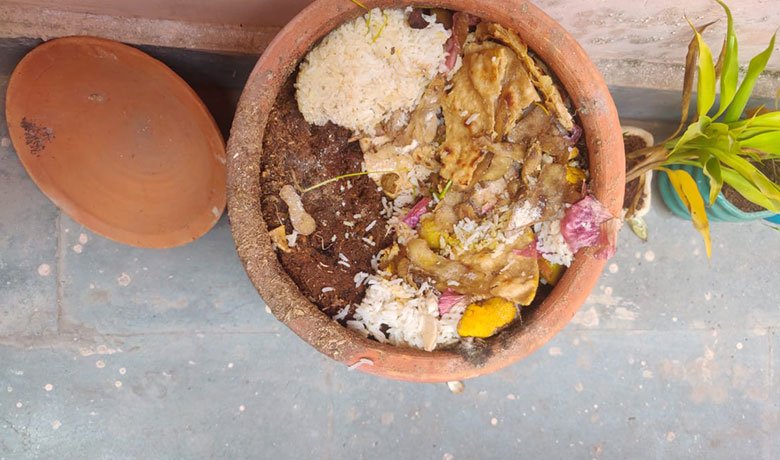
What makes their story powerful is not technology or investment, but intent. Fruit peels, vegetable scraps, tea leaves, leftover food and garden trimmings no longer end up in overflowing bins. Instead, they are turned into something valuable which is nutrient-rich compost, often called black gold.
Learning to Rethink Waste
Kuldeep Choudhary, a resident of Shivpurwa Ward Near Sigra, did not start as an expert in waste management. His journey began when a team from the Varanasi Municipal Corporation (VMC) visited his neighbourhood as part of a door-to-door awareness campaign on home composting.
Trained by the VMC team under the Waste NAMA (Nationally Appropriate Mitigation Action) project, Kuldeep learned how microbial cultures prepared by using cow dung can naturally decompose organic waste. With a little guidance and a lot of curiosity, he decided to try composting at home.
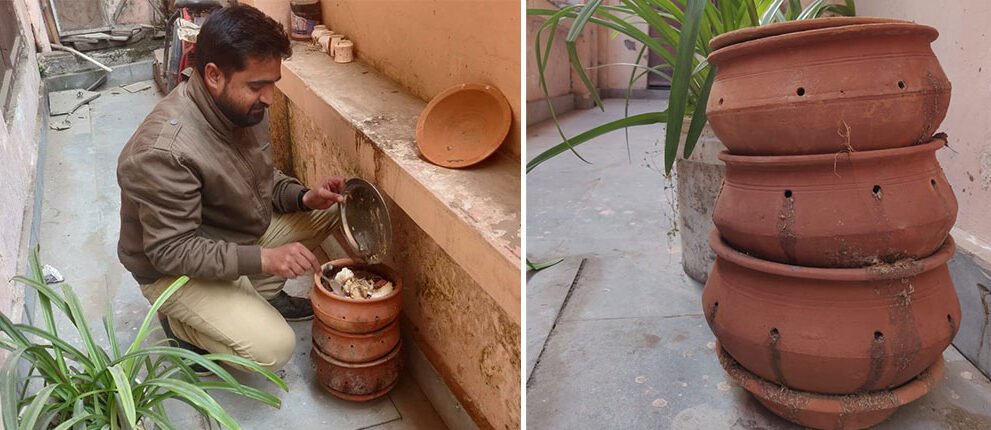
Using a three-layer earthen pot composter which was made locally and set up inside his house, Kuldeep and his family began managing their wet waste themselves.
When Patience Turns Waste into Wealth
Composting is not instant. It demands patience, care and consistency. Over time, the family watched their everyday waste slowly transform into dark brown, crumbly compost with the smell of fresh earth.
This compost now nourishes their home garden, where vegetables, flowering plants and herbs grow without chemical fertilizers. The family’s dependence on store-bought fertilizers has reduced and the soil has become healthier with every cycle.
What was once seen as garbage has now become a resource which now feeds plants, improves soil health and closes the loop between consumption and care.
Impact Beyond One Household
The impact of this simple practice did not stop at Kuldeep’s doorstep. Neighbours began noticing the change i.e. fewer smells, cleaner surroundings and a household that produced almost no wet waste for collection.
Inspired, many families in the colony started composting themselves. Slowly, the volume of waste collected from the area began to reduce. This meant fewer trips for waste transportation and a lower burden on the municipal system.
With less waste reaching landfills, the potential emission of greenhouse gases such as methane also reduced proving that climate action does not always require large-scale projects. Sometimes, it begins at home.
A Win for Waste Collectors and Potters
Segregation of waste also improved the lives of others in the system. The dry waste which is now clean and recyclable became more valuable for informal waste collectors. With better segregation, they could recover more recyclables and earn more from their work.
Unexpectedly, this movement also supported local potters. Earthen composters, used as small bio-reactors, revived demand for traditional pottery. In a time when many potters struggle to keep their craft alive, composting products brought dignity and income back into their hands.
What began as a sustainability practice quietly strengthened livelihoods and cultural crafts.
A Model for Kashi’s Future
Kuldeep Choudhary’s family proves that waste management does not always need large infrastructure. Decentralized home composting can significantly reduce the pressure on cities like Varanasi, where waste generation is growing rapidly.
Their story shows that sustainability is not about perfection, it is about participation. About choosing responsibility over convenience. About seeing waste not as a burden, but as a resource.
Small Actions, Lasting Change
In Kashi, where cycles of life and death are deeply understood, this family reminds us of another cycle that is of renewal. What we discard can return as nourishment. What we waste can become wealth.
Sometimes, gold isn’t mined. It’s composted.