
Varanasi | Humans of Kashi

The Miraculous Durga Idol in Varanasi That Refused to Be Immersed for 258 Years

When Maa Durga’s Idol Did Not Move Even an Inch for Immersion in Kashi The idol has not been immersed for 258 years The Goddess appeared in a dream to the Mukherjee family, asking to remain in Kashi Varanasi. Kashi, the city of Lord Shiva, unique among all the three worlds, is filled with extraordinary mysteries. Resting upon the trident of Lord Shiva, this city has always attracted people with its remarkable miracles. Every year, people come here not only from across India but also from abroad after hearing about the power and miracles of its temples. Today, we introduce one such idol of Adishakti in Kashi. Located in the Jagambari, Madanpura area of Varanasi, this ancient temple, famous as the Old Durga Bari Temple, has remained a center of faith for devotees for centuries. The idol of the Goddess here has not been immersed for 258 years. When the Mukherjee family from West Bengal came to reside in Kashi, they installed the idol of Maa Durga during Durga Puja in the year 1767. On the day of immersion, the Goddess appeared in a dream to the head of the Mukherjee family and expressed her desire to remain there. Since then, this clay idol has remained established at the same place. The idol of Adishakti has been crafted in the Bangla Chala style. This idol of Maa Durga is made from ordinary straw, clay, bamboo, and jute twine, and appears extremely beautiful. The Goddess became so pleased with the worship and devotion of the Mukherjee family that she chose to reside there permanently. Even today, the seventh generation of the Mukherjee family continues to serve the Goddess with devotion. To the right of the idol of Maa Durga stands a black stone idol of Lord Vishnu, which is believed to date back to the 11th century. Even More Than 50 People Could Not Lift the Idol Members of the Mukherjee family residing in the temple premises stated that on Vijayadashami, when people attempted to lift the five-foot-tall idol for immersion, it did not move even an inch from its place. Initially, 15 to 20 people tried to lift the idol. Later, more than 50 people made the attempt, but they still could not move the idol of the Goddess even an inch from its place. On the night of the immersion, the Goddess appeared in a dream to the head of the Mukherjee family. She said that she was extremely pleased with their worship and wished to remain at the same place. Since then, this clay idol of the Goddess has remained enshrined there. Devotees Come from Far and Wide After Hearing of Her Glory After hearing about the glory of Adishakti Maa Durga, devotees from distant places come here during Navratri to seek the Goddess’s blessings. Although the Goddess is worshipped every day, special worship is performed for nine days during Navratri. Jaggery and roasted gram are especially dear offerings to Mata Rani. Devotees visiting from outside also offer roasted gram and jaggery in the temple premises while praying for the fulfillment of their wishes. It is believed that the Goddess fulfills every wish asked with a sincere heart in the temple. The temple remains open every day from 7:30 a.m. to 12:00 p.m. and again from 4:00 p.m. to 8:00 p.m.
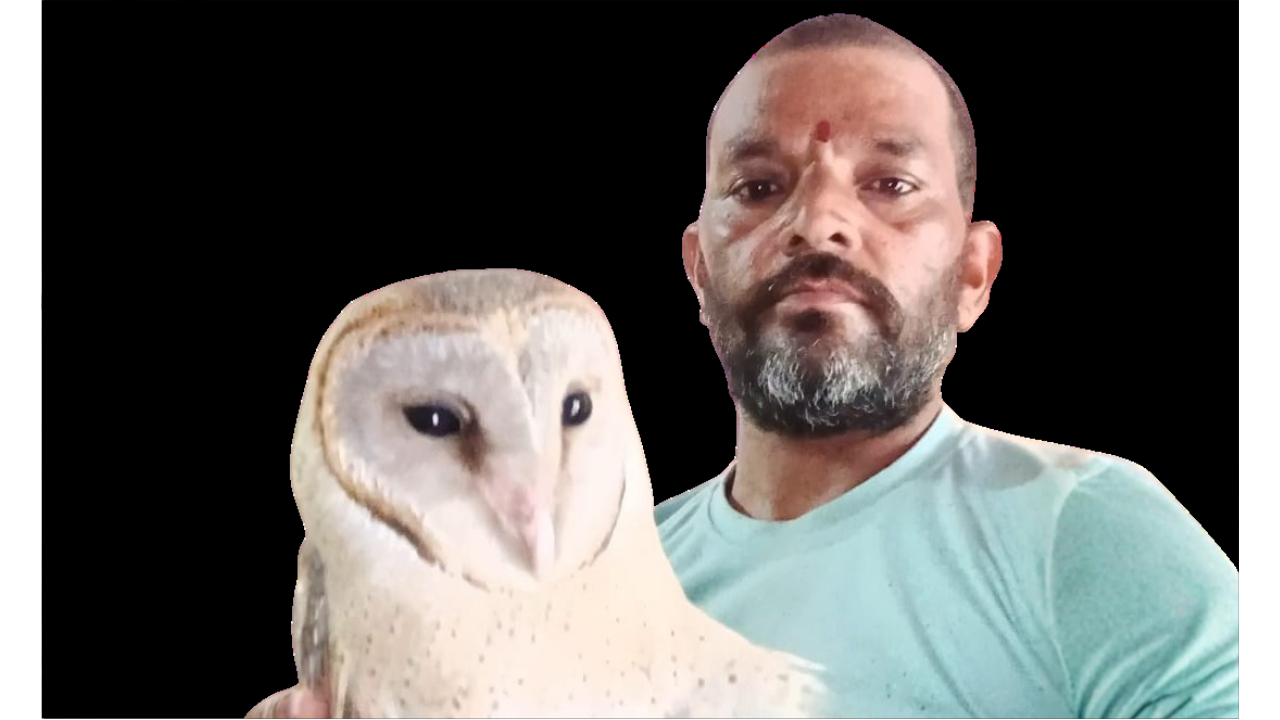
Meet Sunil Lahri: The Banaras Animal Rescuer Who Has Saved 10,000+ Injured Animals in 30 Years

For 30 Years, Sunil Lahri Has Been the Voice of the Voiceless on the Streets of Banaras His heart melted after seeing an injured bull at the age of 15, and since then he has been devoted to serving animals The moment the phone rings, the orange bike ambulance rushes to every corner of the city A tripund on his forehead, a gamcha over his shoulder, and an old orange-colored motorcycle. Looking at Sunil Lahri in a crowd, no one would say that he is one of the most unique social workers in Banaras. Since the age of 15, he has been serving voiceless animals. For the past 30 years, he has been rescuing injured and helpless animals from the streets and providing them with treatment. Sunil’s motorcycle itself is his ambulance. The storage box carries medicines, bandages, husk, and a bag of biscuits. Written on the front of the bike are the words, “Service for Helpless and Injured Animals, Birds and Humanity.” That is his identity. The Story Began with a Bull Sunil says that when he was 15 years old, there was an injured bull lying in his neighborhood. He could not bear to see it suffering. For the first time, he gave the bull water, washed its wounds, and cleaned them. From that moment, a feeling of compassion for animals arose within him, and he has remained connected to serving voiceless creatures ever since. He could not continue his education for long. After completing the fifth standard, he began transporting goods on a trolley at Visheshwarganj Market. After spending the day serving helpless animals, he works in the market transporting goods in the evening. Whenever he spots an injured animal on the road or someone informs him about one, Sunil immediately reaches the location and begins serving the animal. No Degree, But Full of Determination “I don’t have any degree, sir,” Sunil says with a smile. “If I see a wound, I clean it. I apply medicine to help it heal. If the condition is serious, I call a doctor.” Seven years ago, someone threw acid on a Nandi bull. He dressed its wounds for months. When it finally recovered, he released it into the forest. He says, “If I had left it here, it would have been attacked again.” So far, he has served more than 10,000 animals. There is also a small shelter at Domri on the banks of the Ganga, where he treats seriously injured large animals. The Family Opposed Him at First, Now They Support Him Sunil says that whenever an animal was seriously ill, he had no place to keep it, so he would bring it home. On seeing the animals, his mother, Sonmati Devi, would say, “Why do you keep bringing animals home? There is hardly any space here.” Over time, the family also became involved in serving animals. One brother drives a trolley, while another is an auto-rickshaw driver. Both help Sunil financially in his work. Serving animals costs around ₹20,000 every month. Along with Ramji Seth and Keshav Seth, several other animal lovers also support him financially and encourage him to continue serving animals. When the Motorcycle Became an Ambulance Sunil, the friend of voiceless animals, initially served them by travelling on foot and using a trolley. Carrying injured animals from the streets was difficult. Seeing his selfless service, some people came forward to help and arranged a motorcycle for him. As soon as he got the bike, Sunil painted it completely orange. Today, that bright orange motorcycle has become his identity. The words “Service for Helpless and Injured Animals, Birds and Humanity” are written on the front, while the storage box always carries medicines, bandages, ointments, husk, and a bag of biscuits. Whether he receives a phone call from any corner of the city or notices an injured animal on the road, Sunil immediately rides out on his motorcycle. After reaching the spot, he first treats the animal’s wounds and then feeds any hungry animal. The motorcycle is no longer just a vehicle—it has become a moving ambulance on the streets of Banaras. From Sparrows to Peacocks, Every Animal Receives Treatment In the last thirty years, Sunil has treated sparrows, owls, vultures, mules, camels, monkeys, goats, dogs, cows, bulls, and even the national bird, the peacock. He says, “If there is still breath, I pick them up.” Seriously injured large animals are taken to the shelter of the “Helpless and Injured Animals, Birds and Public Service Committee” located at Domri Bandha, Padao. Sometimes it takes four to six months for an animal to recover. During that time, medicines, food, and daily care are provided. Once the animals recover, the larger animals are released into the forest, while the smaller ones are released in safe locations. He Learned the Spirit of Service from Ramji Seth Sunil says that Ramji Seth is his guru. Ramji Seth has been serving animals for 38 years and has rescued more than 6,000 voiceless animals. Due to old age, he now stays at the shelter and looks after the animals. Ramji Seth’s son, Keshav Seth, and the entire family stand by Sunil. Keshav says, “Sunil’s phone number is now known across Banaras. Calls come throughout the day. If Sunil is unavailable, then I, my brother, or my son reaches the spot.” At present, the shelter is treating a blind cow, a cow suffering from lumpy skin disease, an injured calf, and a baby monkey. Keshav says, “Sunil is fulfilling the unfinished dream of my father, Ramji Seth. All of us stand shoulder to shoulder with each other.

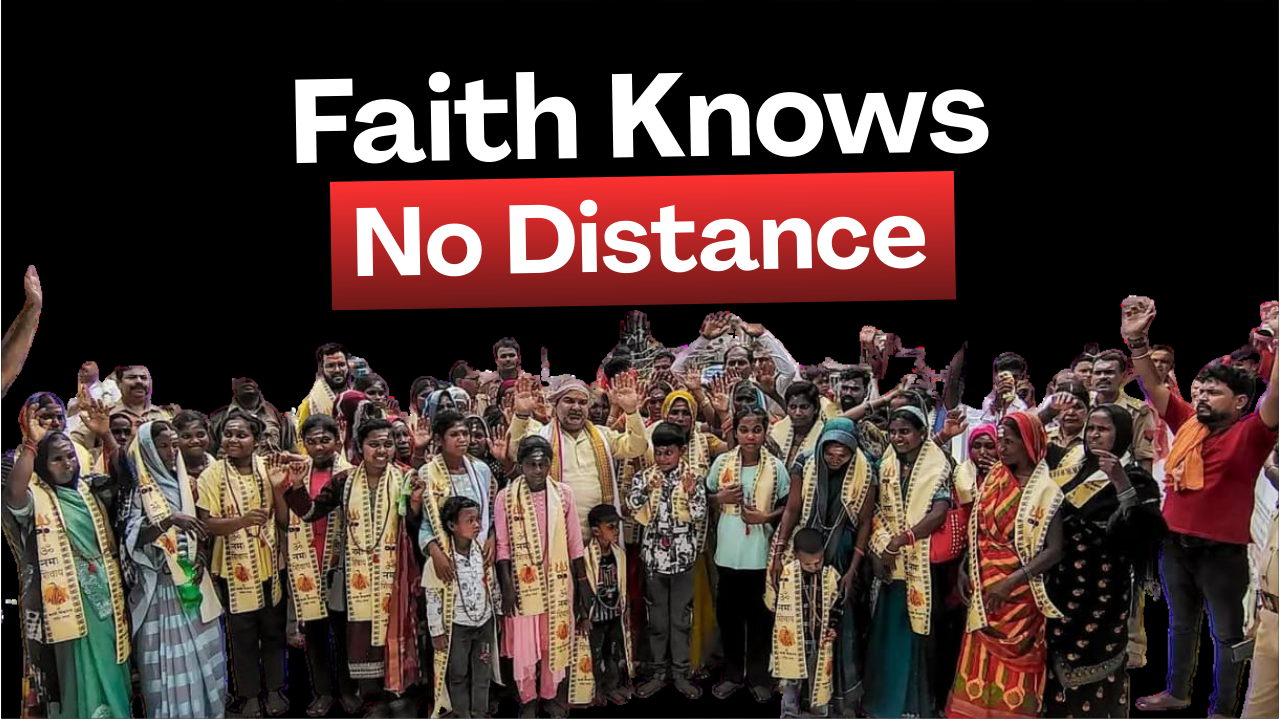
DIG Vaibhav Krishna Fulfills Tribal Women’s Dream of Visiting Kashi Vishwanath for the First Time

DIG Vaibhav Krishna’s Initiative Bears Fruit: Tribal Women Step Out of Their Village for the First Time to Visit Baba Vishwanath The dreams of women from Pandi village, surrounded by hills and forests in Naugarh Block of Chandauli district, came true Seeing a city for the first time brought tears of joy to their eyes, and they appreciated the DIG for fulfilling his promise Varanasi. In today’s modern and dazzling world, where people travel not only across the country but around the globe, there is a village in Uttar Pradesh’s Chandauli district where many residents have never gone beyond their own village. The long-cherished dream of 40 tribal women and 10 men from Pandi village, surrounded by hills and forests in Naugarh Block, came true through an initiative by DIG Vaibhav Krishna. When the women from the Naxal-affected village stepped onto the land of Kashi for the first time, they were overwhelmed with joy. On reaching the court of Baba Vishwanath for the first time, they were welcomed by the temple administration. Experiencing such hospitality for the first time, the happiness was clearly visible on the faces of the women. They offered prayers and performed worship at the Shri Kashi Vishwanath Temple. For the first time, the tribal women not only saw a city but also visited Kashi’s renowned temples. This journey of the tribal women was not merely a religious pilgrimage; it was the fulfillment of one of the biggest dreams of their lives. The Officer Was Moved After Hearing the Women’s Wish A few days ago, DIG of the Varanasi Range, Vaibhav Krishna, visited Pandi village. During his interaction with the village women, he casually asked where they would like to travel if they were given an opportunity. The women’s response moved the officers present there. The women said that they had never seen a city and that their greatest wish was to visit Baba Kashi Vishwanath, Sankat Mochan Temple, Durga Temple, and other prominent temples. Hearing this, the DIG immediately instructed the Chandauli Police to fulfill their wish under the Mission Shakti campaign. Following the instructions, a special police bus reached Pandi village. Forty women and ten men from the village were brought to Varanasi. To ensure security during the journey, two Inspectors and four Sub-Inspectors accompanied them. Chandauli Superintendent of Police Akash Patel said that all the devotees first offered prayers at the Shri Kashi Vishwanath Temple. After that, they were taken to Sankat Mochan Temple, Durga Kund Temple, and other major religious sites of Kashi. A Dream Cherished for Years Came True The women of the village said that they had never seen a city in their lives. Since childhood, they had wished to visit Baba Vishwanath at least once, but due to poor financial conditions and lack of resources, it had never been possible. They said that through the Mission Shakti campaign, their long-cherished wish had finally been fulfilled. Seeing the roads, temples, and vibrant atmosphere of Varanasi for the first time filled them with immense happiness. Pandi Village Lacks Basic Facilities Pandi village, located in the Naugarh region of Chandauli, still remains far removed from the mainstream of development. The village, home to around 80 families, faces a severe drinking water crisis during the summer months. When natural water sources dry up, villagers have to travel long distances to fetch water. Mobile network connectivity is almost nonexistent, affecting communication and leaving the villagers largely disconnected from the outside world. Most families depend on forest resources and daily wage labour for their livelihood. Due to limited income, even meeting everyday needs remains a challenge for them. Who Is the Honest IPS Officer Vaibhav Krishna? Vaibhav Krishna is a 2010-batch IPS officer. He completed his Mechanical Engineering from IIT Roorkee. Vaibhav Krishna secured the 86th rank. He is currently serving as the DIG of the Varanasi Range. He has earned a distinct identity as an honest police officer. He has been in the spotlight for fulfilling the promise he made to the tribal women of Pandi village, located in Naugarh Tehsil near the Bihar border, by taking them on a visit to Kashi under the Mission Shakti campaign on June 14.

How Manoj Yadav Educated 1,000+ Underprivileged Children Despite Leaving College Midway

The Degree Was Left Incomplete, But the Determination Never Broke: Manoj Lit the Lamp of Education in the Lives of Thousands of Children Has educated more than one thousand children so far; many children have passed High School and Intermediate examinations Also conducts online classes through YouTube and provides new and old clothes to underprivileged children Varanasi. Whether in a city or a village, you will find many people with degrees. But there is also a person whose own degree remained incomplete. Even so, he illuminated the lives of thousands of children through education. His name is Manoj Yadav. Children lovingly call him “Guruji.” Living in Ugapur, Pandapur of Cholapur, Manoj has become a ray of hope for those children who cannot even afford school fees. It was in 2013 that Manoj took admission in a graduation course at Banaras Hindu University. He loved studying and had a passion for moving ahead in life. But his pockets were empty. The financial difficulties were so severe that he had to leave his studies midway. His dream of earning a degree remained incomplete. Most people would have stopped there, but Manoj decided that what happened to him due to lack of money should not happen to anyone else. He resolved that no child in his neighborhood would have to leave studies midway because of financial hardship. And that is where the story began. The Classroom Began in the Lanes of a Slum Manoj’s journey was not easy. In the beginning, he had neither benches nor a blackboard to teach children. He gathered children who could not attend school and started teaching them. He taught whatever he knew—Hindi, Mathematics, and English. The fee for his classes was zero. Manoj himself was not financially stable. Despite this, he made every possible effort to light the lamp of education in the lives of poor children around him. His wife Anita supported him wholeheartedly throughout this journey. Anita said, “We may eat less, but we will definitely provide education to children.” That support gave Manoj the courage to continue. What started with one or two children is now transforming the lives of thousands. Manoj says that more than 1,000 children have been associated with him so far. Many of them had never even seen the inside of a school. Manoj taught them, guided them, and got them admitted to government schools. Today, many of those children have passed High School. Some have even completed Intermediate education. One child who could never afford a notebook or pencil is now topping Intermediate examinations. For Manoj, that is the greatest degree of all. Along with Education, He Also Demonstrated Humanity Manoj’s work is not limited to the classroom. When he visits slum settlements and sees children in torn clothes, his heart melts. Along with education, he also made arrangements to clothe the children. He encourages people to donate old clothes for children. Along with collecting used clothes from people, he also buys new clothes for children during festivals. Especially during winters, he visits slum areas and arranges warm clothes for children. Classes Also Run on YouTube Manoj’s classes are now conducted on YouTube as well. As times changed, Manoj adapted too. When mobile phones and the internet became common, he created a YouTube channel. Now, even a child from a remote village can watch his lectures. His online classes maintain the same style—simple language and everyday examples. There are no technical terms, making it easy for children to understand. When a child asks a question in the comments section, Manoj responds through a video. Technology has taken his classroom from the lanes of a slum to the entire state of Uttar Pradesh. Educational Tours for Awareness Social worker Manoj’s goal is not only to provide basic education to children. To help High School and Intermediate students studying in slum settlements fulfill their dreams, he also introduces them to the outside world. For educational tours, he often takes children not only around his city but also to other states. He mostly brings children to Banaras Hindu University by bus. There, he encourages them to pursue higher education and motivates them to study in institutions like BHU. After these educational tours, children become even more enthusiastic about completing their studies. No Big Support, Just a Big Intention Manoj says that when intentions are pure, every destination becomes easier to reach. He believes that society can change only through education. Every poor and deprived person has a right to education. To ensure that children do not face obstacles in education, he has launched a campaign encouraging people to donate ₹100 every month for education. Financial support received from donors also helps in the education of children. He firmly believes that society will change only through education. “I do not have a degree, but sharing knowledge does not reduce knowledge.” Today, Manoj Yadav may not have a paper degree, but he possesses the degree of blessings from thousands of children. People in Cholapur call him “Guruji.” A child who could never even imagine going to school now looks at Manoj and says, “I will study too.” His degree remained incomplete, but his determination never broke. That same determination has rebuilt hundreds of broken dreams. Perhaps this is true education—that a person who could not complete his own studies helps others to study.

Smart Heritage

Smart Heritage: How Kashi is Blending Technology with Tradition

The world calls it modernization. Kashi calls it balance. In recent years, Varanasi has become a symbol of how technology and tradition coexist. As part of the Smart City Mission, the ancient city is undergoing quiet transformations. Kashi is embracing modern technology while staying deeply rooted in its timeless traditions. The goal is not to change the character of the city but to enhance it to create a model city that balances modernisation with the heritage. This initiative focuses on improving quality of life through sustainable development, upgraded infrastructure and more accessible public spaces. Solar-powered streetlights now illuminate the ghats. Digital information kiosks guide tourists through temple trails. CCTV-monitored waste systems keep heritage areas clean. One of the most innovative efforts is the digital mapping of heritage structures, allowing conservationists to monitor temple foundations and ghat erosion in real-time. Redeveloped spaces like Namo Ghat blend spiritual serenity with world class facilities, offering clean water, resting areas and safe public amenities to pilgrims and locals alike. Even the Ganga Aarti is now streamed globally, connecting millions of devotees who can’t physically be there. Every project be it from infrastructure to citizen engagement, reflects a simple truth: Kashi is evolving but never forgetting where it came from.

Where Food and Faith Become One

Banaras: Where Food and Faith Become One

To taste Banaras is to taste devotion. Every corner of the city offers a story in a bowl, from the divine simplicity of Kachori Sabzi at Kachori Gali to the tangy Tamatar Chaat served steaming hot at Dashashwamedh Ghat or to the sweet Malaiyo that melts like morning mist. Here, food isn’t just about flavors; it’s about faith and feeling. Many dishes in Kashi have ritualistic roots Prasads offered in temples, langars during festivals and sweets made in honor of deities. Old families still follow secret recipes passed down for generations. Shops like Kashi Chaat Bhandar and Raja Halwai have become landmarks, where vendors greet you with a smile and stories that stretch back decades. And of course, the Banarasi Paan that seals every meal, fragrant with rose, gulkand and nostalgia. Every meal here connects people, pilgrims, locals and wanderers alike through shared moments of warmth and taste. In Banaras, food and faith are inseparable. Every meal is a celebration, every bite a blessing. The city teaches that the divine can be found not only in temples and rituals but also in the warmth of shared food and the joy of everyday life. Because in Banaras, to eat is to pray and to pray is to taste the eternal.

Kashi Through the Ages

Kashi Through the Ages: The Eternal City That Refuses to Fade

“Older than history, older than tradition, older even than legend and looks twice as old as all of them put together.” – Mark Twain This is Kashi — Varanasi — Banaras, the city where time stands still yet flows like the Ganga. From its mention in the Rigveda to its reverence in the Puranas, Kashi has always been described as the spiritual capital of India, a place where birth and death coexist peacefully. The city’s history stretches back over 3,000 years, making it one of the oldest continuously inhabited cities in the world. Ancient texts describe Kashi as Ananda Vanam, the forest of bliss. It has seen the rise and fall of empires — Mauryan, Gupta, Mughal, British but never lost its soul. The great reformer AdiShankaracharya revived Shaivism here. Saints like Kabir and Tulsidas walked its lanes, composing verses that still echo through the ghats. Even colonial explorers were drawn to its mysticism, calling it “a city of temples, where every stone is a shrine.” Today, while Kashi embraces modernity, new infrastructure, electric boats, a rejuvenated Kashi Vishwanath Corridor, its essence remains timeless. It has always been more than a spiritual hub. It is centre of learning, art, culture, poets and mystics throughout history. To walk through Kashi is to walk through history itself: every step a story, every temple a testament. Kashi’s glow has never dimmed, nor it will. Through the ages, it continues to shine as an eternal city, unbroken and profoundly alive.

If Peace Has a City

If Peace Has a City, It Must Be Kashi

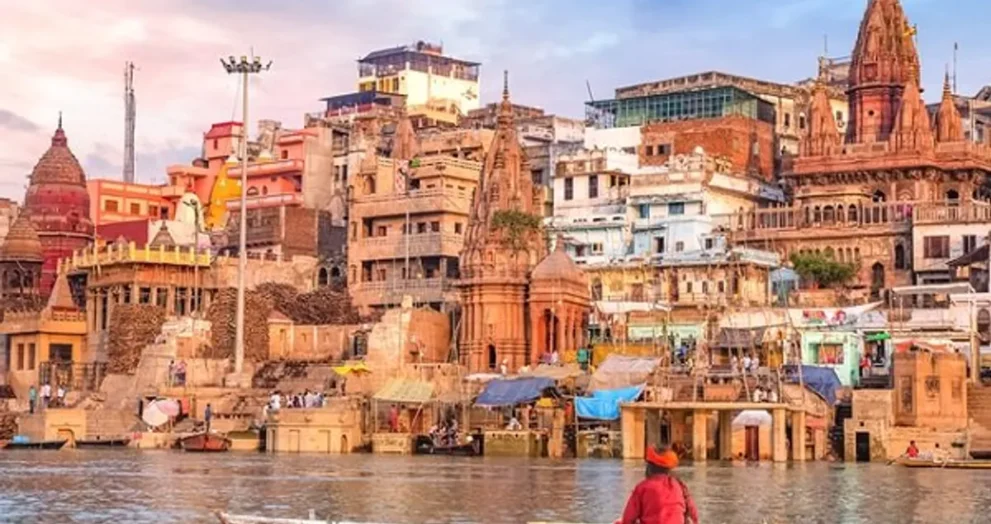
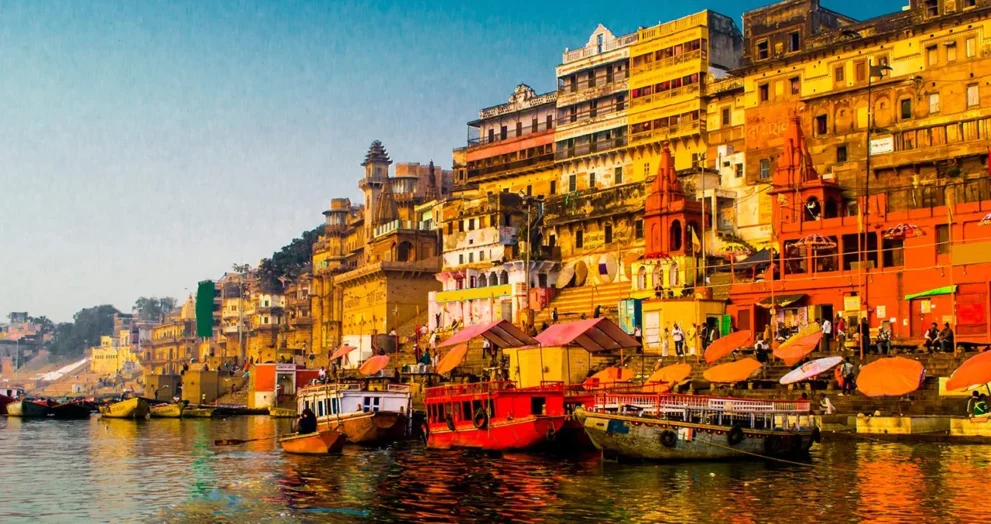
When the first light of dawn touches the ghats, the city wakes not to noise but to prayer. The Ganga shimmers, priests chant, bells echo and the world slows down. This is Banaras, where spirituality and simplicity merge. It is known to be an eternal city where time seems to pause, where chaos finds calm and where the soul finds its rhythm in the hum of mantras along the ghats. Take a morning boat ride on the river and you’ll see stories unfold: monks meditating, tourists in silence, locals performing rituals passed down for centuries. Each ghat tells a tale from Dashashwamedh’s grandeur to Assi’s calm. Beyond the ghats, the narrow lanes reveal the heartbeat of the city, street food stalls, hidden temples, laughing children and the smell of incense. As night falls, the Ganga Aarti paints the sky in gold and sound. For visitors, it’s mesmerizing. For locals, it’s home. Every corner of Kashi holds a story. Every prayer offered here carriers the weight of centuries. The city is ancient yet alive. Here, history. Mythology and faith converge that creates a sanctuary for the spirit. Kashi isn’t just a place you visit; it’s a feeling that stays long after you’ve left.

Banarasi saree

The Looms of Kashi: Threads of Legacy & Livelihood

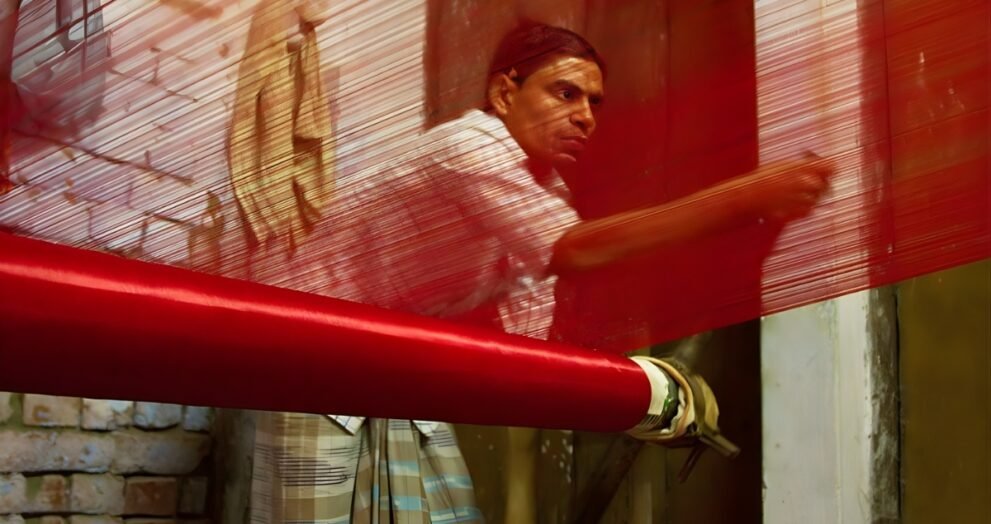
In the dim glow of an oil lamp, a rhythmic clatter echoes — tak-tak-tak. It’s the sound of a weaver’s life in Varanasi. Kashi’s weaving tradition dates back centuries, with references to its exquisite fabrics found in ancient texts like the Rig Veda and the Mahabharata. For centuries, the Banarasi saree has been India’s fabric of grace, worn in weddings and worship alike. Yet behind its shimmering zari lies the untold struggle of thousands of weavers. Documentary films like Bunkar have highlighted their plight but also their pride. NGOs and government schemes are trying to revive the art through training, digital sales and exhibitions. Each saree is a work of art that can take weeks, sometimes months to complete. Every motif from kalga to bel is a silent prayer woven into the thread. These artisans aren’t just weaving fabric; they are preserving the heritage. Every saree they create carries within it stories, emotions and timeless traditions. To own a Banarasi saree is to hold a piece of India’s soul which is a living legacy of art, culture and devotion passed from mother to daughter, generation to generation. Families in areas like Madanpura and Lallapura have carried this craft for generations. But as machine-made fabrics flooded markets, traditional handlooms began to fall silent. “I learnt weaving from my father when I was ten” says 56-year-old Mohammad Idris. “Now my sons don’t want to continue as there’s no stability.” Despite challenges, the loom keeps beating. Because in Banaras, weaving isn’t just a livelihood, it’s devotion woven into silk.

Banaras First Net-Zero Library

Banaras First Net-Zero Library: Where Tradition Meets Innovation

In a city known for its temples and timeless chants, a new temple of learning is taking shape that is powered not by faith but by sunlight. By 2026, Varanasi will host India’s first Net-Zero Library, a green-tech marvel where heritage design meets sustainability. This project is led by Varanasi Development Authority (VDA). It is located at the LT College campus; this library aims to create a fully self-sustaining educational space one that generates as much energy as it consumes. The architecture reflects the ethos of Kashi blending sandstone facades, jaali windows and open courtyards with solar panels, rainwater harvesting systems, energy efficient systems and passive cooling structures. Students and locals alike will have access to digital learning zones, archives of ancient manuscripts and a sustainable public space to read and reflect. It will have a seating capacity for 500 people with over 35,000 books. “We want to make Kashi a global example of how heritage and innovation can coexist beautifully” said a senior official from the Varanasi Development Authority. The project not only symbolizes India’s green future but also honors the ancient city’s tradition of wisdom, now reborn through modern design. The design of library is inspired by the sacred Ganga River and traditional temple aesthetics.

  • 1
  • 2